Announcements, BWWC, CFP

CFP for BWWC 2025 in Sioux Fall, South Dakota: Apply by Dec. 15, 2024!


The organizers of the 2025 British Women Writers Conference have released their full Call for Papers:

BWWC 2025 will focus on the theme “Transformations” as it relates to texts produced by women, nonbinary, and gender-nonconforming individuals within global and transatlantic contexts during the long eighteenth and nineteenth centuries. The organizers wish to consider how these texts represent, reflect, and embody transformation, as well as how they have proved and continue to prove transformative. How might the study of these texts generate transformation within the classroom, academic programs and disciplines, educational institutions, and academia at large? How might this work contribute to social, political, and ecological transformation at a time when efforts to address humanitarian and environmental crises are routinely and systematically met with resistance? What transformations must occur to ensure that the conditions of academic work are just, humane, ethical, and equitable?

See the full CFP, including submission guidelines and topic suggestions, here.

Announcements, BWWC, CFP

Full CFP for BWWC Colorado in 2024 out Now!

The organizers of the 2024 British Women Writers Conference have released the full Call for Papers:

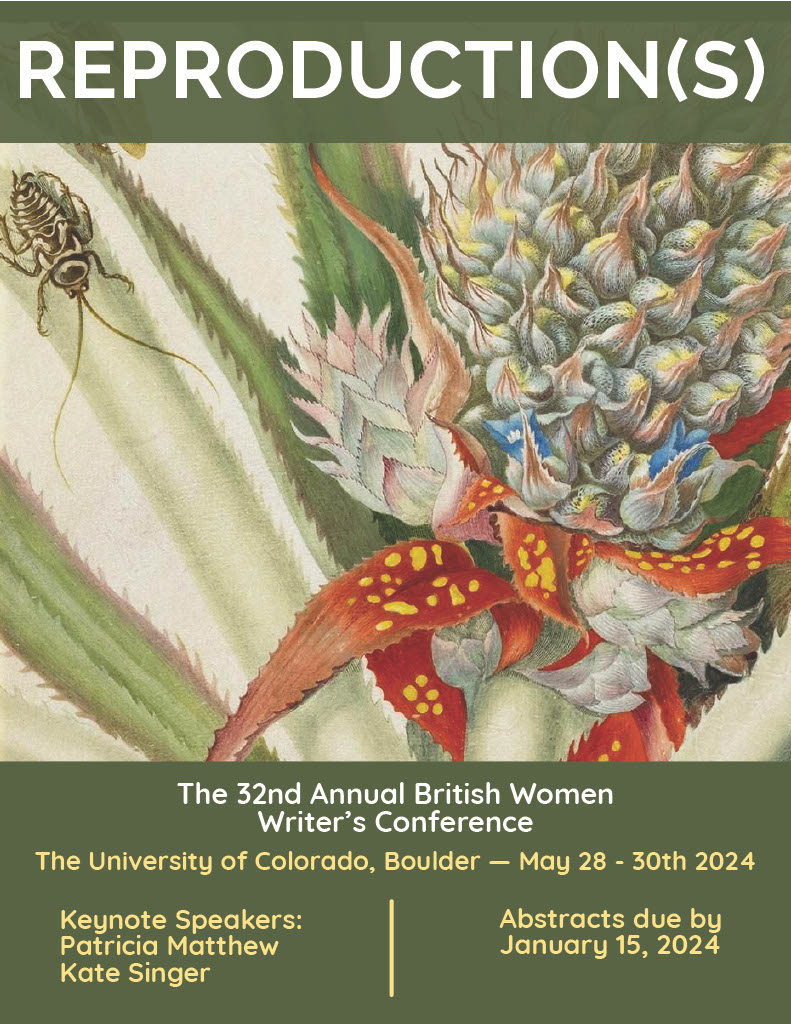
The organizers of the 2024 BWWC invite papers and panel proposals related to the theme of “Reproduction(s)” in global, transatlantic, and British women’s writing from the long eighteenth century to the present. Beyond the more obvious correlation between this theme and the centrality of reproductive rights to women’s lives, a vital resonance exists between this topic and the commitment of the British Women Writers Association to recover “women/womxn from the margins to the center of literary history.” The act of recovery (and all forms of reproduction, for that matter) contains the potential for re-emergence and mutation—for moments of slippage and opportunities for change. Participants are encouraged to be especially aware of the potential for disruption embedded within the concept/practice/enactment of reproduction(s).

This year’s organizers have deliberately chosen the plural form of “reproduction” because the word is simultaneously a noun, a verb, and an adjective. Also, reproduction is both biological and technological, as seen in the reverberating effects the industrial revolution had on blurring the supposed boundaries between women’s labor, leisure, and traditional familial structures. The ways in which aesthetics and print culture reproduce these cultural tensions reveal the continual transformations and mutations of women’s roles in society.

Intimately tied to these issues are forms of familial reproduction, ranging from eighteenth-century laws regarding inheritance to the suffrage movement of the twenty-first century. While many women were embracing new roles, their self-enacted freedoms often outpaced their legal rights. This topic is especially relevant when considering that women of color who suffered because of the transatlantic slave trade and colonialism had even fewer legal rights than white women of the middle and upper classes.

Of great interest are subversive methods of reproducing knowledge, for example, unsanctioned communication networks and the re-appropriation of cultural reproductions. It would be especially beneficial to have contributions that embrace alternative approaches to “reproducing” the traditional archive. In the spirit of reproduction(s), the organizers look forward to reading proposals that play with and challenge the limits of this theme.

See the full CFP, including submission guidelines and topic suggestions, here.

Announcements

Calls for BWWA Chair & Vice Chair (Closed)

The BWWA Executive Board invites nominations for the positions of Chair and Vice Chair. These positions are elected by the BWWA members and serve for 2-4 years. Descriptions of the positions’ main responsibilities are:

The Chair (term of 2 years)

  • Serves as executive officer, setting meeting agendas, appointing board members, and creating ad hoc committees if necessary; 
  • Assists BWWC organizers in the conference organizing process, including recruiting
  • future host institutions and coordinating host organization proposal approval;
  • Organizes Association and Advisory board meetings, trains Vice Chair, 
  • Advises Board as Past Chair, and serves as an Association Board member after their tenure as Chair expires.

The Vice Chair (term of 2 years; followed by 2-year term as Chair)

  • Advises the Chair and acts as Chair in Chair’s absence.
  • Oversees Travel Award committee and chairs Nominations and Elections Committee
  • Serves as Chair after completion of two-year term as Vice Chair.

Those interested in learning more in the positions may contact Roxanne Eberle at eberle@uga.edu or Donelle Ruwe at Donelle.Ruwe@nau.edu for more information. 

 Please submit a letter of interest and CV by Friday, October 14, 2022 to BWWA.contact@gmail.com if you wish to run for either of these positions.

Announcements

Call for Web and Media Manager of the BWWA (Closed)

The British Women Writers Association (BWWA) seeks self-nominations and nominations by others for a Web and Media Manager (WAMM). The WAMM is responsible for website design, administration, and maintenance. Intended for both an internal and an external audience, the website provides information about membership, governance, past and future conferences, and awards. The WAMM, along with the Communications Director, also publishes updates and announcements on social media and relevant listservs and responds to emails sent to the Association.

The WAMM is an appointed position and serves on the Executive Board. All nominations will be considered by the members of the Executive and Association Boards, who will appoint the new WAMM from the pool of nominations. To nominate yourself, submit a short letter of interest and your CV to kleuner@scu.edu. If you are nominated by another, the BWWA will contact you and solicit a CV and letter of interest. Nominations are due by Friday, October 14, 2022. If you have questions about the role, direct them to Kirstyn Leuner kleuner@scu.edu.

Announcements, BWWC, CFP

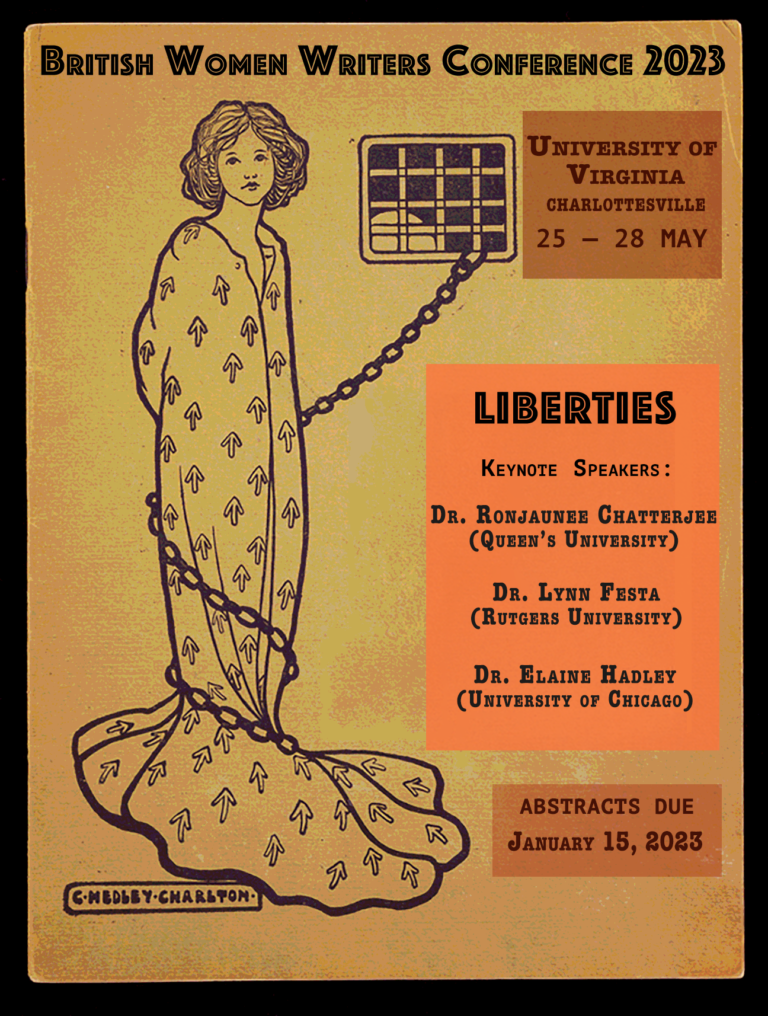
2023 BWWC CFP “Liberties” (deadline extended to Jan. 31, 2023)

The organizers of the 2023 BWWC invite papers and panel proposals (UPDATE: submission deadline extended to January 31, 2023) interpreting the theme of ‘Liberties’ in global and transatlantic British women’s writing from the long eighteenth century to the present. We ask participants to consider ‘liberties’ not only as a political abstraction but also as part of material and experiential subjectivity. Interpreted broadly, liberties include (but are not limited to) legal rights and freedoms, liberty of the person and bodily autonomy, liberties of creative and artistic expression, liberty of profession and vocation, freedom of movement both physical and social, and self-determination in the private and public spheres. How far did these liberties extend to women at different historical moments? Were liberties granted by the state and other institutions or taken despite them? How were they imagined and realized differently by women across categories of race, class, ethnicity, nationality, sexuality, age, ability? We invite presenters to contextualize ‘liberties’ in terms of both its capacities and practices as well as its limits and exclusions.

British history of the eighteenth and nineteenth centuries poses conflicting and contradictory narratives of liberty. The abolition of the slave trade did not end indentured labor in the colonies. The expansion of the franchise through legislation did not extend the vote to women and the poor. Free trade and market liberalism increased Britain’s wealth but also aggravated socioeconomic inequalities. The rhetorics of emancipation at home contrasted with the realities of imperial rule abroad. How can we make sense of these partial and conditional liberties using literary history? Whose liberty is centered in literary, historical, and political narratives? How is liberty represented in women’s writing — as aspiration, transgression, fantasy, lack? We welcome scholarship that puts the construct of liberty under critical scrutiny and interrogates its relationship to ongoing and incomplete struggles for liberation. We also welcome presentations and panel proposals on pedagogy. How can we draw connections in our teaching between literary history and the liberationist movements of the present? Short talks on pedagogical methodology, classroom practices, use of digital and other media tools, or collective and community-facing projects are highly encouraged.

Submit your CFP here: http://bwwc23.com/submission-form/

Possible topics for papers and panels include:

Political liberties

Women and nationhood, women’s civic participation, women and human rights, anti-slavery and abolition, empire and anti-colonialism, suffrage and women’s liberation

Social liberties

Women’s education, women’s work and the professions, women travelers and migration, women’s associations and societies, liberty and domesticity

Liberties of the body

Reproductive liberties, sex and sexuality, desire and consent, queer bodies, women’s physical cultures, women and disability

Liberties of expression

Gender and performance, women’s self-fashioning, women’s art and aesthetics, women and publicity, women and print culture, women’s intellectual histories

Announcements, CFP

Romantic Circles/K-SAA Anti-Racist Pedagogies Colloquium Fellowship

Call for Fellows (due June 15)

RC Pedagogies and K-SAA see the work of discovering, gathering, developing, and elaborating anti-racist pedagogies as essential to the work of scholars and teachers, not to mention to the viability and relevance of the Romantic period more generally. Since systemic racism has long affected not only what texts are considered canonical, but also how, where, and to whom Romantic-era materials are taught, RC Pedagogies and K-SAA hope to provide support for scholars in expanding access to Romantic-era pedagogy, including resources for teaching in underserved communities and carceral facilities. Such an undertaking must be a collaborative, sustained, and rigorous research project to include bibliographies of available material, articles discussing best classroom practices, contextual materials, and syllabi, compiled into a readily usable/accessible set of pages to be maintained over time.

A joint team of K-SAA and RC scholars seek to appoint a team of 4 Pedagogies Fellows tasked with adding to a permanent yet expanding set of anti-racist pedagogy web links and resources begun by last year’s amazing Fellows (Mahasweta Baxipatra, Conny Cassity, Hilary Fezzy, Lenora Hanson, Indu Ohri, and Erin Saladin). The Colloquium to be held over Zoom during several meetings over four weeks during July-August 2022. Fellows would receive a $500 honorarium, and specific dates for the colloquium will be crowd-sourced by the fellows and convener. Over the course of that month, Fellows would, together and independently, locate helpful contextual sources, syllabi, articles, and techniques for anti-racist pedagogy in the Romantic period, as well as organize and annotate these items into accessible webcontent for teachers of high school, undergraduate, graduate students, and other learners.

Throughout the colloquium, Fellows will be encouraged (but not required) to share their work through online social fora like Twitter and HASTAC. At the month’s end, the group will identify future work for the participants of this colloquium and colloquia to come, which may include blogging for the K-SAA Blog, a series of short essays for RC, a conference panel, a special issue, or another form of work. (This colloquium is the second in a series of continuing work.)

Fellows will have the opportunity to build a cohort and a virtual space for discussion of anti-racist pedagogy and its intellectual work. They will also receive mentoring via senior scholar-teachers in the field via guests and speakers as well as other members of the K-SAA/RC Pedagogies team. Fellows can thus expect to become part of a widening professional network of Romantic scholars, digital humanists, and teachers, especially in their unique relationship to Romantic Circles and K-SAA as organizations with journals and other scholarly events. Additionally, Fellows will gain exposure to journal, organization, and advisory board projects.

Applicants of any rank are invited to submit a one-page letter of intent to keatshelleyassociation@gmail.com by June 15th, which discusses specific interests and experience in anti-racist pedagogy, including discussion/description of courses taught or proposed as well as scholarly research/interests and public humanities work.

image credit: https://www.vecteezy.com/vector-art/225445-megaphone-icons-vector
Announcements, BWWC

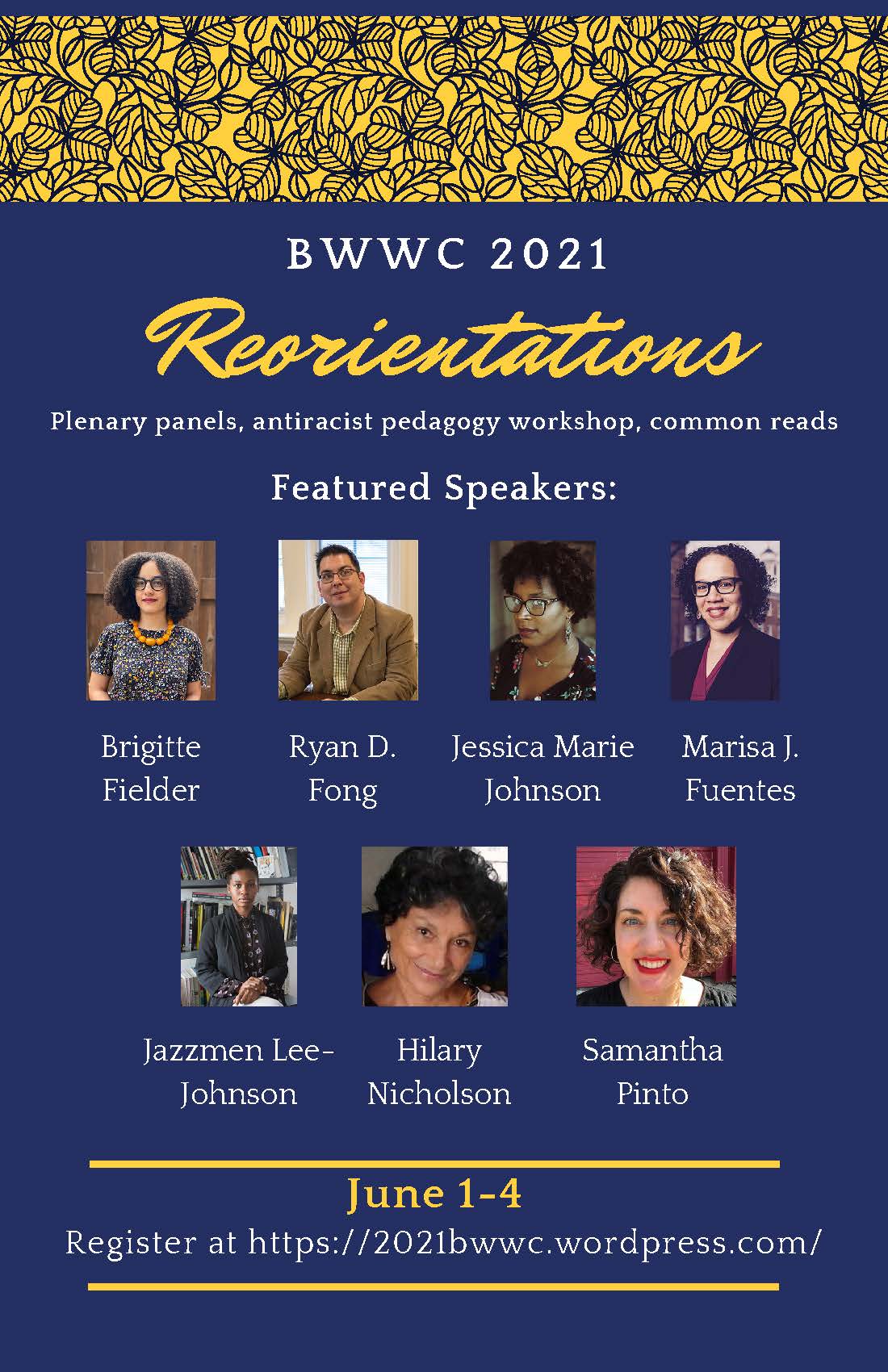
Register for the 2021 BWWC, “Reorientations” (1-4 June 2021)

Registration is now live for the June 1-4 2021 BWWC!

Please fill out this form to register for the conference and receive the needed Zoom link. Remember to click “submit” on the second screen of the form.

Following your submission of the form, you will receive an email confirmation with a single Zoom link that will allow you to access each day’s events. You will also be prompted to submit your BWWA dues at https://britishwomenwriters.org/association/membership/.

The conference organizers and the BWWA are excited to welcome you all to our virtual conference in June!

If you’re on the fence, check on the impressive list of speakers and our schedule.

photo source https://en.wikipedia.org/wiki/Phillis_Wheatley#/media/File:Phillis_Wheatley_frontispiece.jpg
Announcements

Join the New BWWA Association Board

UPDATE May 2021: These positions have been filled.

As the British Women Writers Association (BWWA) approaches its 30th anniversary in June 2022, we would like to invite interested scholars of the long 18th and 19th centuries to help us expand participation in the Association’s governance. Specifically, we invite applications to serve on our new Association Board. 

The Association Board is the governing body of the BWWA and will contain nine members, in addition to the members of the Executive Committee and past Chairs. They are encouraged to attend the annual board meeting during the annual British Women Writers Conference (BWWC); they recruit potential conference hosts and promote the BWWC in professional venues; and they help solicit papers and/or organize panels for the annual conference. Association Board members will be appointed for 2021-22, and afterward will be elected to serve terms of a minimum of two years, and may stand for re-election.

If you are interested in serving on the Association Board, please send a letter of interest and your CV by December 20 to BWWA Co-President Roxanne Eberle: eberle@uga.edu.

Eligibility: 

  • Scholarly expertise in the British women writers of the long 18th and 19th centuries
  • Any rank (graduate students, independent scholars, tenure-track professors, contingent faculty, etc.)