Uncategorized

CFP for Vernon Lee Conference (U Liverpool, 1-3 September 2026)

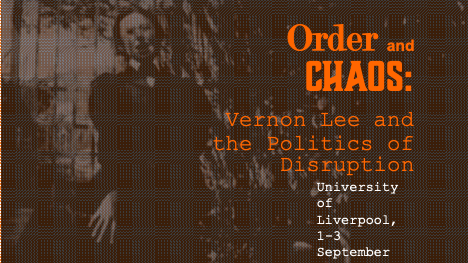
Order and Chaos: Vernon Lee and the Politics of Disruption

University of Liverpool, School of the Arts Library, 1-3 September 2026. Attendance online will also be available. Registration opens 1 May 2026.

“It is only in our own day that people are beginning to question the perfection of established rules of conduct, to discuss the drawbacks of duty and self-sacrifice, and to speculate upon the possible futility of all ethical systems, nay, upon the possible vanity of all ideals and formulas whatever.” — Vernon Lee, Gospels of Anarchy, 1909

A radical breakdown of trust in institutions across government, media, education, religion—is currently gripping Western Europe and the US. An atmosphere of uncertainty and fear has been created: for individuals, for groups holding common goals, and even for whole nations as the spectres of authoritarianism and anarchy become increasingly real. Among much else, freedom of thought the right of assembly, personal/medical rights, gender preference and expression, efforts to save the environment—all are under attack throughout the world.

In 1908, Vernon Lee (1856-1935)—a writer always sensitive to new political, social and cultural formations—wrote Gospels of Anarchy with her signature blend of irony, and literary flair. The book explores, and sometimes devastates, the theories of Order and Anarchy, and of Utopia and Dystopia, promulgated by literary and philosophical giants of thenineteenth century such as Emerson, Tolstoi, Nietzsche, William James and H. G. Wells. In 1912, her book Vital Lies expanded on these themes. In a manifesto that speaks loudly to our own era of post-truth politics, she vehemently attacked those who were “redefining truth in such a way as to include edifying and efficacious fallacy and falsehood” and thus helping to dissolve the whole idea of truth altogether.

This conference aims to explore the political questions and challenges we face today through the lens that Vernon Lee brought to the same kind of challenges in her time: a lens that is simultaneously thought-provoking, curious, playful, radical, and multidisciplinary. Papers may wish to explore the breakdown and/or the imposition of illusory order or structure in various fields (educational, social, commercial, entertainment, literary, scientific, information), what damage it is doing and whether it can somehow be harnessed or managed to be beneficial; how resistance, rebellion and nonconformity in public, academic, and private life, thought and publication can modify “however infinitesimally, the opinions and ideals and institutions of the present and the future” as Lee suggests in Gospels of Anarchy.

We welcome presentations, lightning presentations, panels/ roundtables, workshops, or creative practice sessions that engage with the following topics (but are not limited to):

  • Freedom of Thought, Speech, and Expression
  • Pacifism, anti-violence, anti-nationalism, anti-imperialism
  • Protest, strikes, rebellion
  • Philosophy, ethics, and morality (individual, governmental, national, corporate)
  • Feminisms, local, global and radical
  • Trans studies
  • Human and animal rights
  • Psychology, psychiatry, neurology, and mental health
  • Environment, ecology, and the Anthropocene
  • Sustainable futures
  • Education and self-development

We would particularly like to hear about the ways in which Lee’s works speak to current events and trends, and postulate or enable the development of healthy, sustainable futures.

Papers (15 minutes) roundtable/ panel (60 mins), workshops (60 mins), creative practice session (60 mins), and lightning papers (10 mins).

We would be delighted to discuss proposals for panels or individual presentations, and to answer any questions you may have. Please submit questions, abstracts (300 words) and a short bio (100 words) in a Word/ GoogleDoc to the review committee email vernonleealliance@gmail.com by 18 January 2026.

Thanks to the generosity of the International Vernon Lee Society, we hope to offer bursaries to early-career/precarious scholars – more details on the application process will be made available in due course.

The conference is organized by members of The Vernon Lee Alliance (VLA):  Matthew Bradley (The University of Liverpool, UK), Elisa Bizzotto (Iuav University of Venice, Italy), Sally Blackburn-Daniels (Teesside University, UK), Mary F. Burns (Independent Scholar, US), Mandy Gagel (University of Michigan, US), Mary Clai Jones (Chadron State College, US), Tomi-Ann Roberts (Colorado College, US).
Uncategorized

CFP for BWWC 2018 (Abstracts due 12/8/17)

Call for Papers

18th- and 19th-century British Women Writers Conference

April 11-15, 2018

The University of Texas at Austin

The twenty-sixth annual BWWC invites papers and panel proposals interpreting the theme of “New Directions.” Since the landmark “Generations” conference of 2017 invites a retrospective look back, “New Directions” will encourage turning to the future to ask crucial methodological, theoretical, and content-based questions about our fields’ key concepts and literatures. [Go to the 2018 conference website.]

What do we mean by “British”? By “women”? By “writers”? We welcome papers and panel proposals addressing change, development, destabilization, and potential in terms of both British women writers and the field of British women writers scholarship. We envision panels focused around the stability of gender-, nation-, and profession-based abstractions, as well as research on individuals living at the margins of these terms.

By December 8, 2017, send 300-word abstracts for paper proposals, along with a brief bio (in one document) to:

bwwc2018@gmail.com

Panel proposals should include individual paper abstracts, short speaker bios, as well as a brief panel description (in one document). All proposals must engage the conference theme and relate to British women’s writing in the span between the eighteenth and early twentieth centuries. Graduate students are encouraged to apply for a travel grant sponsored by the BWWA.

Possible topics may include but are not limited to:

Feminist Intersections
Intersectionality
Space & Place Tension between/among feminisms
Post-structural feminism
Ecofeminism
Materialisms

Frontiers
Empire and expansion
Shifting borders
Transatlantic movement
Exploration and discovery
Postcolonial theory

Space & Place
Space and temporalities
Industrialization
Archives
The country and the city

Identity 
Fraught national identity
Trans- and queer theories
Racial spectacle/ the raced body
The subaltern/ colonization
Diversity in the academy

(R)evolutions
Enlightenment philosophy
The scientific revolution
Women in/and science
Technology
Digital pedagogy

Literary Directions
(De)constructing the canon
New directions for literary criticism
Genre stability/ instability
Visual texts
Strategic presentism

Narrative Directions
Travel writing
Mapping & globalization
Adaptations & revisions
Formal invention & experimentation
Epistolary networks

Uncategorized

BWWA Travel Grant, 2017

  • Be currently enrolled as full time graduate students;
  • Be currently employed in non-tenured, part-time, or adjunct positions; or
  • Have completed their doctorates within the last ten years and be unaffiliated with any university.
Please submit the following information as an attachment to lisa.hager@uwc.edu by March 1, 2017:
  • A copy of your conference proposal;
  • A brief cover letter specifying
    • Award being applied for: Graduate Student Travel Award or Independent Scholar/Contingent Faculty Travel Award;
    • Information regarding your previous affiliation with the BWWA;
    • Anticipated travel distance;
    • Any other pertinent details of employment.
 Submission Directions:
  • All of the application documents should be part of one single attachment file;
  • The attachment should be a MS Word .doc or Adobe .pdf;
  • The file name should start with the applicant’s last name (ex. smith_bwwcapp.doc);
  • The subject line of the email should indicate
    • Award being applied for: Graduate Student Travel Award or Independent Scholar/Contingent Faculty Travel Award;
    • Period that best fits the project:
      • early to mid-18th century;
      • late 18th century to early 19th century;
      • mid-19th century to early 20th century.
Uncategorized

CFP: BWWC 2017, 25th Anniversary Conference

Twitter Banner_08.31.16.jpgFor its 25th annual meeting, the British Women Writers Conference invites papers and panel proposals considering the theme of “Generations.” As we look back on a quarter-century of feminist scholarship and practice within British Studies, we want to celebrate those who have defined the British Women Writers Association’s past and nurture those who will shape its future. Of course, even within literary traditions or scholarly networks, generational transitions are rarely ever easy or smooth. Such transitions may be accompanied by paradigm shifts, struggles to be heard, or difficulty letting go. We therefore welcome investigations into the complexities of generational exchange and transition in women’s writing. Papers may focus on generation as a biological, cultural, social, historical, or political process as well as on attendant manifestations in eighteenth- and nineteenth-century literature and contemporary scholarly discourses. In the end, we hope that a comprehensive exploration of generations will help illuminate shifts in literary studies, women’s writing, and critical practice.

By January 15, 2017, send 300-word abstracts for paper proposals, along with a brief bio (in one document) to bwwc2017@gmail.com. Panel proposals should include individual paper abstracts, short speaker bios, as well as a brief panel description (in one document). All proposals must engage the conference theme and relate to British women’s writing during the long eighteenth or nineteenth centuries. Graduate students are encouraged to apply for a travel grant sponsored by the BWWA.

Possible topics may include, but are not limited to:

  • “GENERATIONS AND RELATIONS”: parents & children; mentors & mentees; ancestors & descendants; inter/extra-generational friendships; generational conflict
  • “GROWING PAINS”: theories of change & the passing of time; obsolescence of cultural practices & social structures; new technologies & techniques; biopower, eugenics, social design
  • “SEASONS”: weddings, honeymoons, anniversaries; political & economic phases; schedules, timetables, deadlines; geological time, astronomical time, relativity; retrospectives & futurisms; literary periodization
  • “SEEDS”: horticulture, cultivation, conservation; cuisine & consumption; changing landscapes & cityscapes
  • “GENRES OF GENERATION”: proceedings, requiems, obituaries; borrowings, adaptations, revisions; multi-generational texts; narrative inventions & residuals; changing aspects & visual arts; performing change & changing performances
  • “PHASES OF HUMAN BODIES”: reproduction, pregnancy, birth, maternity; childhood & adolescence; theories of biological (re)generation & healing; carework & disability; discourses of aging bodies or minds & ageism; death & mourning
  • “BWWC’S 25TH”: 1992-2017: reminiscences & outlooks; critical & feminist prehistories; anxieties of influence; the state of the field; women’s writing as a category of analysis; scholarship as pedagogy; interdiscipinarity; whither BWWC?
Uncategorized

Program for the 1st Annual BWWC (1992)

Have you wondered what the first British Women Writers Conference was like, who presented, and what topics were covered? Thanks to Donelle Ruwe and Roxanne Eberle, we have an archive of nearly every program in the 25-year history of this unique conference. (The 2017 conference at UNC-Chapel Hill will be the 25th anniversary conference.) Together, these programs reveal part of the history of scholars’ recovery of women writers, how this work has changed, and how the field has grown since the early 1990s.

Each program will soon be accessible on the Annual Conference page of the website.

1st Annual BWWC Program (1992)

Uncategorized

CFP: Special Issue of Women’s Writing, “Generations”

RWOWSpecial Issue Call for Papers

WOMEN’S WRITING

“Generations”

Winter 2017 Issue

In honor of the 25th anniversary of the British Women Writers Association in 2017, Women’s Writing invites submissions for a special issue on the theme of “Generations.” While generational transitions are often productive and even revolutionary, they are seldom ever easy or smooth. Such transitions may be accompanied by paradigm shifts, struggles to be heard, or difficulty letting go. In this spirit, the editors especially welcome investigations into the complexities of generational exchange and transition in the field of women’s writing.

Papers may focus on generation as a biological, cultural, social, historical, or political process as well as on attendant manifestations in eighteenth- and nineteenth-century literature and contemporary scholarly discourses. Explorations should illuminate shifts in literary studies, women’s writing, and/or critical practice.

Topics may included but are not limited to: mentoring relationships, conflicts across the generations, literary periodization, models of literary production, theories of regeneration, reproduction and maternity, feminist prehistories, and the future of women’s writing.

We invite essays of 4,000-7,000 words in length (including notes) for the Winter 2017 issue.

Please submit abstracts of 200 words to the editors, Doreen Thierauf and Lauren Pinkerton (University of North Carolina at Chapel Hill) at generations2017@unc.edu, by August 1, 2016.

Complete essays will be due February 1, 2017. Please prepare contributions according to MLA style (8th edition) and in accordance with the journal’s author guidelines and style sheet (to be accessed on this page: http://www.tandf.co.uk/journals/authors/style/layout/style_rwow.pdf).

Uncategorized

Announcing BWWC 2016 “Making a Scene”, UGA (Athens, GA) June 2-5

Screen Shot 2015-09-02 at 9.51.53 AM

Call for Papers

24th Annual Meeting of the British Women Writers Conference
June 2-5, 2016
Hosted by the University of Georgia
Athens, GA

Download pdf version here.

UPDATE: Abstracts are due January 15, 2016. See below for details.

The theme of the 24th annual meeting of the British Women Writers Conference is “Making a Scene,” and we’re excited to welcome papers that play with the elasticity of this phrase vis-à-vis eighteenth- and nineteenth-century writings by women. From the sublime panoramas of “Beachy Head” and the scandalous rehearsals of Lover’s Vows in Mansfield Park to the landscapes of Helen Huntingdon and the ekphrastic poems of Michael Field, eighteenth- and nineteenth-century literature by British women writers frequently makes a scene as it considers landscape, theatrical performance, and the creation or representation of visual art. Additionally, actresses themselves enrich women’s writing of the period; the works and life writings of Charlotte Charke and Fanny Kemble remind us that actresses formed a vital part of the canon of eighteenth- and nineteenth-century women writers.

But “making a scene” is also a breach of social decorum; it runs the risk, as Haywood’s Fantomina learns despite her calculated use of disguise, of revealing the desire underneath a too ostentatious flirtation. Or it shatters protocol by suggesting the vehemence of any passion. For political radicals also make scenes in British literature, and Barrett Browning’s “Runaway Slave” delivers a powerful one at Pilgrim’s Point. Barrett Browning reminds us that making a scene is often a radical, transgressive act, particularly for an eighteenth- or nineteenth-century woman, whose need to be witnessed, heard, or even seen defies the social and political architecture that tries to silence her.

We invite papers and panel proposals that consider any facet of this theme, particularly those in relation to writing scenes, scenes of the mind, landscapes, political demonstrations, courtroom outbursts, and performance more generally. For paper proposals, please send a 300-word abstract and a short bio (in a single attachment) to bwwc2016@gmail.com by January 15, 2016. For full panel proposals, please compile all proposals, along with a brief rationale for the panel, into a single document. Papers and panels must address the theme and its application to British women’s literature of the long eighteenth- or nineteenth-centuries. Graduate students whose submissions are accepted may apply to receive a travel grant sponsored by the British Women Writers Association.

Possible topics may include, but are not limited to:

Scenes from the Arts

  • Theatrical Performance
  • Drama
  • Painting
  • Sculpture
  • Landscapes
  • Decorative Arts
  • Children’s Arts
  • Arts and Crafts
  • Ekphrasis
  • Scenes of Writing
  • Travel Writing
  • Metafiction
  • Settings
  • Unrepresentable Settings

Internal Scenes

  • Scenes of the Mind
  • Memory
  • Daydreams
  • Political Dreams
  • Utopias

Public Scenes

  • The Performance of Everyday Life
  • The Performance of Gender
  • The Performance of Community
  • Emotional Scenes
  • Realism

Political Scenes

  • Demonstrations
  • Courtrooms
  • Legislative Scenes
  • Campaigns
  • Patriotism
  • Radicalism

Scenes of the Body

  • Bodies on Display
  • The Performance of Sexuality
  • Sexology
  • Flirtation
  • Disability and Display

Scenes of the Nation

  • Performing Patriotism
  • Performing Race
  • Performing Empire
  • Racism

Scenes of Instruction

  • Classrooms and Pedagogy
  • Friendships and Performativity
  • The Discipline of Children
  • Dioramas
  • Museums
  • Libraries
  • The Great Exhibition

Commercial Scenes

  • Advertisements
  • Window Displays
  • Professionalism/Amateurism
  • Cosmopolitanism
  • Flânerie and Gender

We greatly look forward to your proposals on these and other relevant topics!

Continue reading “Announcing BWWC 2016 “Making a Scene”, UGA (Athens, GA) June 2-5″

Uncategorized

BWWC 2015 Reminders

The 23rd annual British Women Writers Conference, this year from June 25th-27th, is fast approaching! Visit the conference website for updates and to register: https://britishwomenwriters2015.wordpress.com/.

There’s a lot to look forward to:

* Keynotes from Mary Jean Corbet and Nancy Yousef.

* Trips to the Berg and the Pforzheimer Collections at the New York Public Library

* A pre-conference reception on Wednesday the 24th and a welcome reception on Thursday the 25th

* A banquet dinner at a neighborhood restaurant

* And of course, a great lineup of speakers for our panels and roundtables.

We look forward to seeing you there!

Please be in touch with any questions: bwwc2015@gmail.com