Uncategorized

CFP: BWWC 2017, 25th Anniversary Conference

Twitter Banner_08.31.16.jpgFor its 25th annual meeting, the British Women Writers Conference invites papers and panel proposals considering the theme of “Generations.” As we look back on a quarter-century of feminist scholarship and practice within British Studies, we want to celebrate those who have defined the British Women Writers Association’s past and nurture those who will shape its future. Of course, even within literary traditions or scholarly networks, generational transitions are rarely ever easy or smooth. Such transitions may be accompanied by paradigm shifts, struggles to be heard, or difficulty letting go. We therefore welcome investigations into the complexities of generational exchange and transition in women’s writing. Papers may focus on generation as a biological, cultural, social, historical, or political process as well as on attendant manifestations in eighteenth- and nineteenth-century literature and contemporary scholarly discourses. In the end, we hope that a comprehensive exploration of generations will help illuminate shifts in literary studies, women’s writing, and critical practice.

By January 15, 2017, send 300-word abstracts for paper proposals, along with a brief bio (in one document) to bwwc2017@gmail.com. Panel proposals should include individual paper abstracts, short speaker bios, as well as a brief panel description (in one document). All proposals must engage the conference theme and relate to British women’s writing during the long eighteenth or nineteenth centuries. Graduate students are encouraged to apply for a travel grant sponsored by the BWWA.

Possible topics may include, but are not limited to:

  • “GENERATIONS AND RELATIONS”: parents & children; mentors & mentees; ancestors & descendants; inter/extra-generational friendships; generational conflict
  • “GROWING PAINS”: theories of change & the passing of time; obsolescence of cultural practices & social structures; new technologies & techniques; biopower, eugenics, social design
  • “SEASONS”: weddings, honeymoons, anniversaries; political & economic phases; schedules, timetables, deadlines; geological time, astronomical time, relativity; retrospectives & futurisms; literary periodization
  • “SEEDS”: horticulture, cultivation, conservation; cuisine & consumption; changing landscapes & cityscapes
  • “GENRES OF GENERATION”: proceedings, requiems, obituaries; borrowings, adaptations, revisions; multi-generational texts; narrative inventions & residuals; changing aspects & visual arts; performing change & changing performances
  • “PHASES OF HUMAN BODIES”: reproduction, pregnancy, birth, maternity; childhood & adolescence; theories of biological (re)generation & healing; carework & disability; discourses of aging bodies or minds & ageism; death & mourning
  • “BWWC’S 25TH”: 1992-2017: reminiscences & outlooks; critical & feminist prehistories; anxieties of influence; the state of the field; women’s writing as a category of analysis; scholarship as pedagogy; interdiscipinarity; whither BWWC?
Uncategorized

Program for the 1st Annual BWWC (1992)

Have you wondered what the first British Women Writers Conference was like, who presented, and what topics were covered? Thanks to Donelle Ruwe and Roxanne Eberle, we have an archive of nearly every program in the 25-year history of this unique conference. (The 2017 conference at UNC-Chapel Hill will be the 25th anniversary conference.) Together, these programs reveal part of the history of scholars’ recovery of women writers, how this work has changed, and how the field has grown since the early 1990s.

Each program will soon be accessible on the Annual Conference page of the website.

1st Annual BWWC Program (1992)

Announcements, BWWC

Remembering Pam Corpron Parker

It is with deepest sympathy and heartfelt sadness that we share the news that Pam Corpron Parker passed away on August 2, 2016. Pam was the co-founder of the 18th- and 19th-Century British Women Writers Association and the keeper of the spirit of this organization and its conference. She welcomed and inspired attendees, mentored graduate student organizers, and advised many organizing committees since the beginnings of the BWWA in 1991. She was an incisive scholar and dedicated teacher and friend to her students at Whitworth University and beyond. Our field and, indeed, our world is the lesser for her absence.

Here is a link to her obituary, where you can also leave a message in the guest book. 

As part of our 25th Anniversary conference at UNC-Chapel Hill, in June 2017, we will be sharing remembrances of Pam, and we will also pass them along to her family.

13653025_10210094450182622_1189562244382317291_o
Toasting the 20th Anniversary BWWC in 2012. L-R: Roxanne Eberle, Pam Corpron Parker, Troy Bassett, Donelle Ruwe
Uncategorized

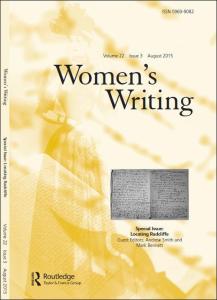
CFP: Special Issue of Women’s Writing, “Generations”

RWOWSpecial Issue Call for Papers

WOMEN’S WRITING

“Generations”

Winter 2017 Issue

In honor of the 25th anniversary of the British Women Writers Association in 2017, Women’s Writing invites submissions for a special issue on the theme of “Generations.” While generational transitions are often productive and even revolutionary, they are seldom ever easy or smooth. Such transitions may be accompanied by paradigm shifts, struggles to be heard, or difficulty letting go. In this spirit, the editors especially welcome investigations into the complexities of generational exchange and transition in the field of women’s writing.

Papers may focus on generation as a biological, cultural, social, historical, or political process as well as on attendant manifestations in eighteenth- and nineteenth-century literature and contemporary scholarly discourses. Explorations should illuminate shifts in literary studies, women’s writing, and/or critical practice.

Topics may included but are not limited to: mentoring relationships, conflicts across the generations, literary periodization, models of literary production, theories of regeneration, reproduction and maternity, feminist prehistories, and the future of women’s writing.

We invite essays of 4,000-7,000 words in length (including notes) for the Winter 2017 issue.

Please submit abstracts of 200 words to the editors, Doreen Thierauf and Lauren Pinkerton (University of North Carolina at Chapel Hill) at generations2017@unc.edu, by August 1, 2016.

Complete essays will be due February 1, 2017. Please prepare contributions according to MLA style (8th edition) and in accordance with the journal’s author guidelines and style sheet (to be accessed on this page: http://www.tandf.co.uk/journals/authors/style/layout/style_rwow.pdf).

Uncategorized

Announcing BWWC 2016 “Making a Scene”, UGA (Athens, GA) June 2-5

Screen Shot 2015-09-02 at 9.51.53 AM

Call for Papers

24th Annual Meeting of the British Women Writers Conference
June 2-5, 2016
Hosted by the University of Georgia
Athens, GA

Download pdf version here.

UPDATE: Abstracts are due January 15, 2016. See below for details.

The theme of the 24th annual meeting of the British Women Writers Conference is “Making a Scene,” and we’re excited to welcome papers that play with the elasticity of this phrase vis-à-vis eighteenth- and nineteenth-century writings by women. From the sublime panoramas of “Beachy Head” and the scandalous rehearsals of Lover’s Vows in Mansfield Park to the landscapes of Helen Huntingdon and the ekphrastic poems of Michael Field, eighteenth- and nineteenth-century literature by British women writers frequently makes a scene as it considers landscape, theatrical performance, and the creation or representation of visual art. Additionally, actresses themselves enrich women’s writing of the period; the works and life writings of Charlotte Charke and Fanny Kemble remind us that actresses formed a vital part of the canon of eighteenth- and nineteenth-century women writers.

But “making a scene” is also a breach of social decorum; it runs the risk, as Haywood’s Fantomina learns despite her calculated use of disguise, of revealing the desire underneath a too ostentatious flirtation. Or it shatters protocol by suggesting the vehemence of any passion. For political radicals also make scenes in British literature, and Barrett Browning’s “Runaway Slave” delivers a powerful one at Pilgrim’s Point. Barrett Browning reminds us that making a scene is often a radical, transgressive act, particularly for an eighteenth- or nineteenth-century woman, whose need to be witnessed, heard, or even seen defies the social and political architecture that tries to silence her.

We invite papers and panel proposals that consider any facet of this theme, particularly those in relation to writing scenes, scenes of the mind, landscapes, political demonstrations, courtroom outbursts, and performance more generally. For paper proposals, please send a 300-word abstract and a short bio (in a single attachment) to bwwc2016@gmail.com by January 15, 2016. For full panel proposals, please compile all proposals, along with a brief rationale for the panel, into a single document. Papers and panels must address the theme and its application to British women’s literature of the long eighteenth- or nineteenth-centuries. Graduate students whose submissions are accepted may apply to receive a travel grant sponsored by the British Women Writers Association.

Possible topics may include, but are not limited to:

Scenes from the Arts

  • Theatrical Performance
  • Drama
  • Painting
  • Sculpture
  • Landscapes
  • Decorative Arts
  • Children’s Arts
  • Arts and Crafts
  • Ekphrasis
  • Scenes of Writing
  • Travel Writing
  • Metafiction
  • Settings
  • Unrepresentable Settings

Internal Scenes

  • Scenes of the Mind
  • Memory
  • Daydreams
  • Political Dreams
  • Utopias

Public Scenes

  • The Performance of Everyday Life
  • The Performance of Gender
  • The Performance of Community
  • Emotional Scenes
  • Realism

Political Scenes

  • Demonstrations
  • Courtrooms
  • Legislative Scenes
  • Campaigns
  • Patriotism
  • Radicalism

Scenes of the Body

  • Bodies on Display
  • The Performance of Sexuality
  • Sexology
  • Flirtation
  • Disability and Display

Scenes of the Nation

  • Performing Patriotism
  • Performing Race
  • Performing Empire
  • Racism

Scenes of Instruction

  • Classrooms and Pedagogy
  • Friendships and Performativity
  • The Discipline of Children
  • Dioramas
  • Museums
  • Libraries
  • The Great Exhibition

Commercial Scenes

  • Advertisements
  • Window Displays
  • Professionalism/Amateurism
  • Cosmopolitanism
  • Flânerie and Gender

We greatly look forward to your proposals on these and other relevant topics!

Continue reading “Announcing BWWC 2016 “Making a Scene”, UGA (Athens, GA) June 2-5″

Uncategorized

BWWC 2015 Reminders

The 23rd annual British Women Writers Conference, this year from June 25th-27th, is fast approaching! Visit the conference website for updates and to register: https://britishwomenwriters2015.wordpress.com/.

There’s a lot to look forward to:

* Keynotes from Mary Jean Corbet and Nancy Yousef.

* Trips to the Berg and the Pforzheimer Collections at the New York Public Library

* A pre-conference reception on Wednesday the 24th and a welcome reception on Thursday the 25th

* A banquet dinner at a neighborhood restaurant

* And of course, a great lineup of speakers for our panels and roundtables.

We look forward to seeing you there!

Please be in touch with any questions: bwwc2015@gmail.com

Announcements, BWWC, CFP

CFP: BWWC 2015

Call for Papers (Updated 9/28/14)

BWWC 2015 CFP Image_Relations

23rd Annual Meeting of the British Women Writers Conference: “Relations”
June 25th-27th, 2015
Hosted by The Graduate Center of the City University of New York
at The Heyman Center, Columbia University

Relations

The British Women Writers Conference will engage the theme of “Relations” for its 23rd annual meeting to be held in New York City. The inspiration for this theme comes from Eve Kosofsky Sedgwick, who taught at the Graduate Center from 1998-2009, and whose investment in relations continues to inspire new ways of looking at the richness and variance of (dis)connection. One of her last courses, “Reading Relations,” explored literary constructions and alternative understandings of relationality (the syllabus for the course can be seen here). Sedgwick’s interdisciplinary approach informs our conference’s investments. In this spirit, we invite papers—as well as panel proposals—that focus on possible interpretations of and approaches to relationality across a broad spectrum of topics, methods, and disciplines. We would welcome investigations of interaction, exchange, correlation, or conjunction. Alternately, treatments might focus on relationality as a political, historical, global, social, personal, critical or textual phenomenon.

For paper proposals, please send a 300-word abstract and a short bio (in a single attachment) to bwwc2015@gmail.com by January 5, 2015. For full panel proposals, please compile all proposals, along with a brief rationale for the panel, into a single document. Papers and panels must address the theme and its application to British women’s literature of the long 18th- or 19th-centuries. Graduate students whose submissions are accepted may apply to receive a travel grant sponsored by the British Women Writers Association.

Possible topics may include, but are not limited to:

Conceptual Relations:
Influence (literary or otherwise)
Subject-Object relations
Human-Animal relations
Human-Machine relations
Darwinian relations
Affect
Connection
Complementarity
Synthesis
Affiliation
Collaboration
Spatial arrangements/Bodies in space
Communication

Personal Relations:
Sexual relations/Intimate relations
Interiority
Domestic arrangements
Care-giving, professional and personal
Courtship/Marriage/Divorce
Familial Relationships/Kinship
Friendship

Global Relations:
Cosmopolitanism
Economic systems
Trade
Exploration
Anthropological interactions

Social/Political Relations:
Social arrangements
Class relations
Labor relations
Gender relations
Community
Political relationships
Revolutionary relations
Colonial relations
Race relations
Cross-national/cross-cultural relations
Historical connections

Critical/Textual Relations:
Theoretical approaches
Hermeneutic relations
Reader relations
Biographical relationships
Literary circles/networks
Relations between literary forms/genres/traditions/
conventions
Palimpsests

Pedagogical Relations:
Pedagogical approaches
Text-Media relations
Interdisciplinarity
Adaptations

Image caption: Dido Belle with her cousin Lady Elizabeth Murray, formerly attrib. Johann Zoffany, 1779.

Announcements, BWWC, CFP

BWWC 2014 CFP Extension to Jan. 17th

EXTENDED DEADLINE (1/17/14): British Women Writers Conference @ Binghamton University (SUNY): June 19-21, 2014

full name / name of organization:
Eighteenth- and Nineteenth-Century British Women Writers Conference
contact email:
bwwc2014@gmail.com

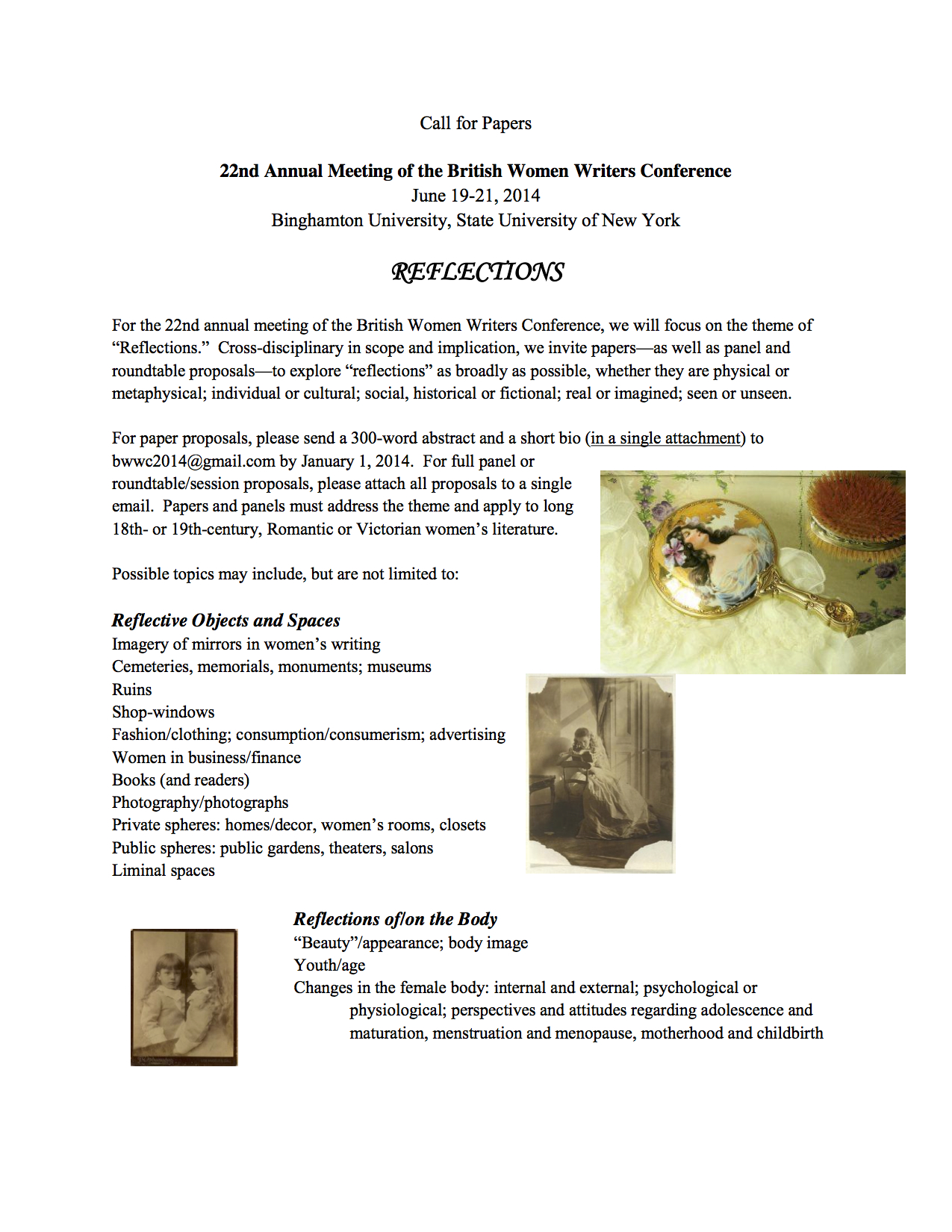
“REFLECTIONS”

22nd Annual Meeting of the British Women Writers Conference
June 19-21, 2014
Binghamton University, State University of New York

For the 22nd annual meeting of the British Women Writers Conference, we will focus on the theme of “Reflections.” Cross-disciplinary in scope and implication, we invite papers—as well as panel and roundtable proposals—to explore “reflections” as broadly as possible, whether they are physical or metaphysical; individual or cultural; social, historical or fictional; real or imagined; seen or unseen.

For paper proposals, please send a 300-word abstract and a short bio (in a single attachment) to bwwc2014@gmail.com by January 17, 2014. For full panel or roundtable/session proposals, please attach all proposals to a single email. Papers and panels must address the theme and apply to long 18th- or 19th-century, Romantic or Victorian women’s literature. For more information, please see our website at http://bwwc2014.wordpress.com.

Possible topics may include, but are not limited to:

Reflective Objects and Spaces

Imagery of mirrors in women’s writing
Cemeteries, memorials, monuments; museums
Ruins
Shop-windows
Fashion/clothing; consumption/consumerism; advertising
Women in business/finance
Books (and readers)
Photography/photographs
Private spheres: homes/decor, women’s rooms, closets
Public spheres: public gardens, theaters, salons
Liminal spaces

Reflections of/on the Body

“Beauty”/appearance; body image
Youth/age
Changes in the female body: internal and external; psychological or
physiological; perspectives and attitudes regarding adolescence and
maturation, menstruation and menopause, motherhood and childbirth
Health/disease
Disability
Gender and sexuality
Body as reflection of the unconscious

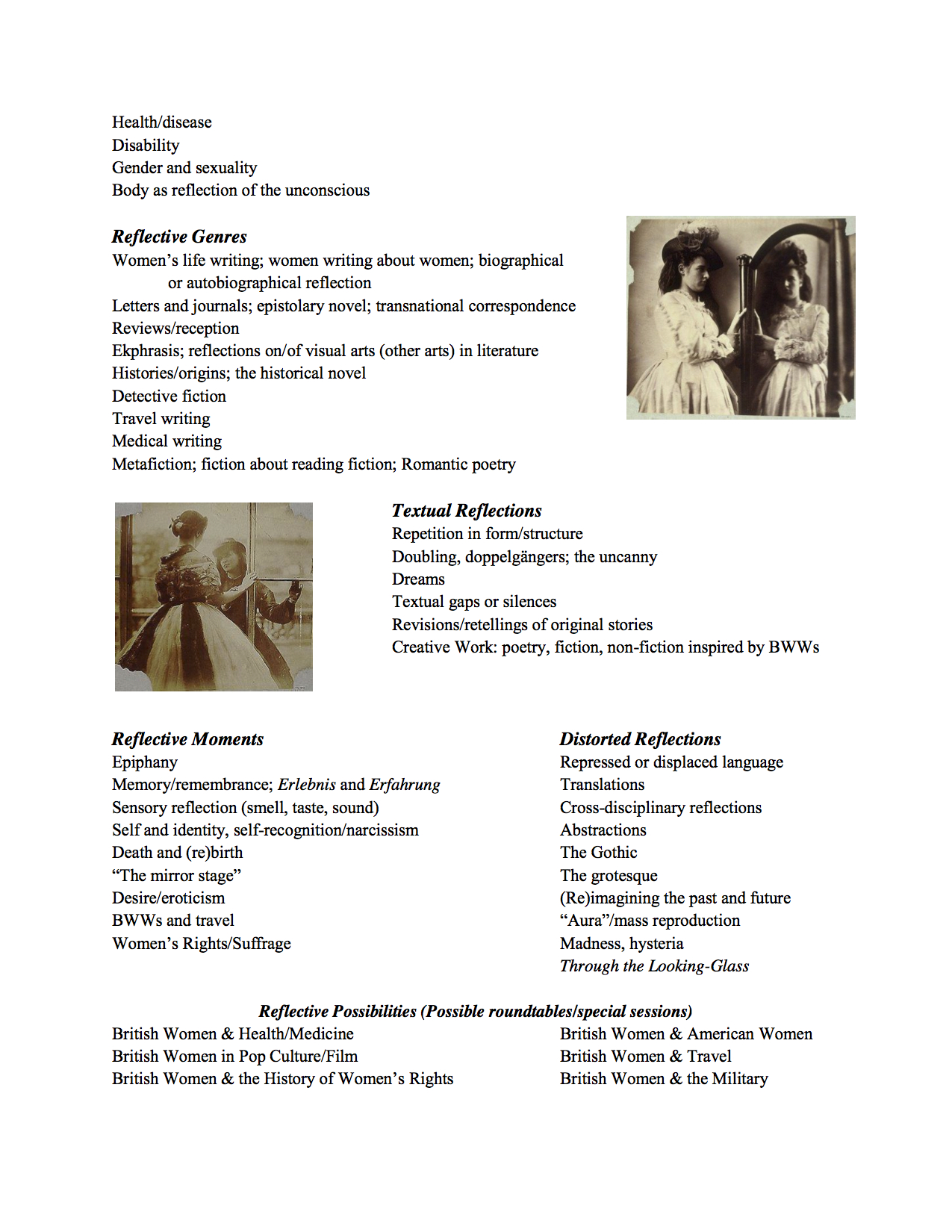
Reflective Genres

Women’s life writing; women writing about women; biographical
or autobiographical reflection
Letters and journals; epistolary novel; transnational correspondence
Reviews/reception
Ekphrasis; reflections on/of visual arts (other arts) in literature
Histories/origins; the historical novel
Detective fiction
Travel writing
Medical writing
Metafiction; fiction about reading fiction; Romantic poetry

Textual Reflections

Repetition in form/structure
Doubling, doppelgängers; the uncanny
Dreams
Textual gaps or silences
Revisions/retellings of original stories
Creative Work: poetry, fiction, non-fiction inspired by BWWs

Reflective Moments

Epiphany
Memory/remembrance; Erlebnis and Erfahrung
Sensory reflection (smell, taste, sound)
Self and identity, self-recognition/narcissism
Death and (re)birth
“The mirror stage”
Desire/eroticism
BWWs and travel
Women’s rights/suffrage

Distorted Reflections

Repressed or displaced language
Translations
Cross-disciplinary reflections
Abstractions
The Gothic
The grotesque
(Re)imagining the past and future
“Aura”/mass reproduction
Madness, hysteria
Through the Looking-Glass

Reflective Possibilities
(Possible roundtables/special sessions)

British Women & Health/Medicine
British Women & American Women
British Women in Pop Culture/Film
British Women & Travel
British Women & the History of Women’s Rights
British Women & the Military
British Women Writers & Digital Humanities